
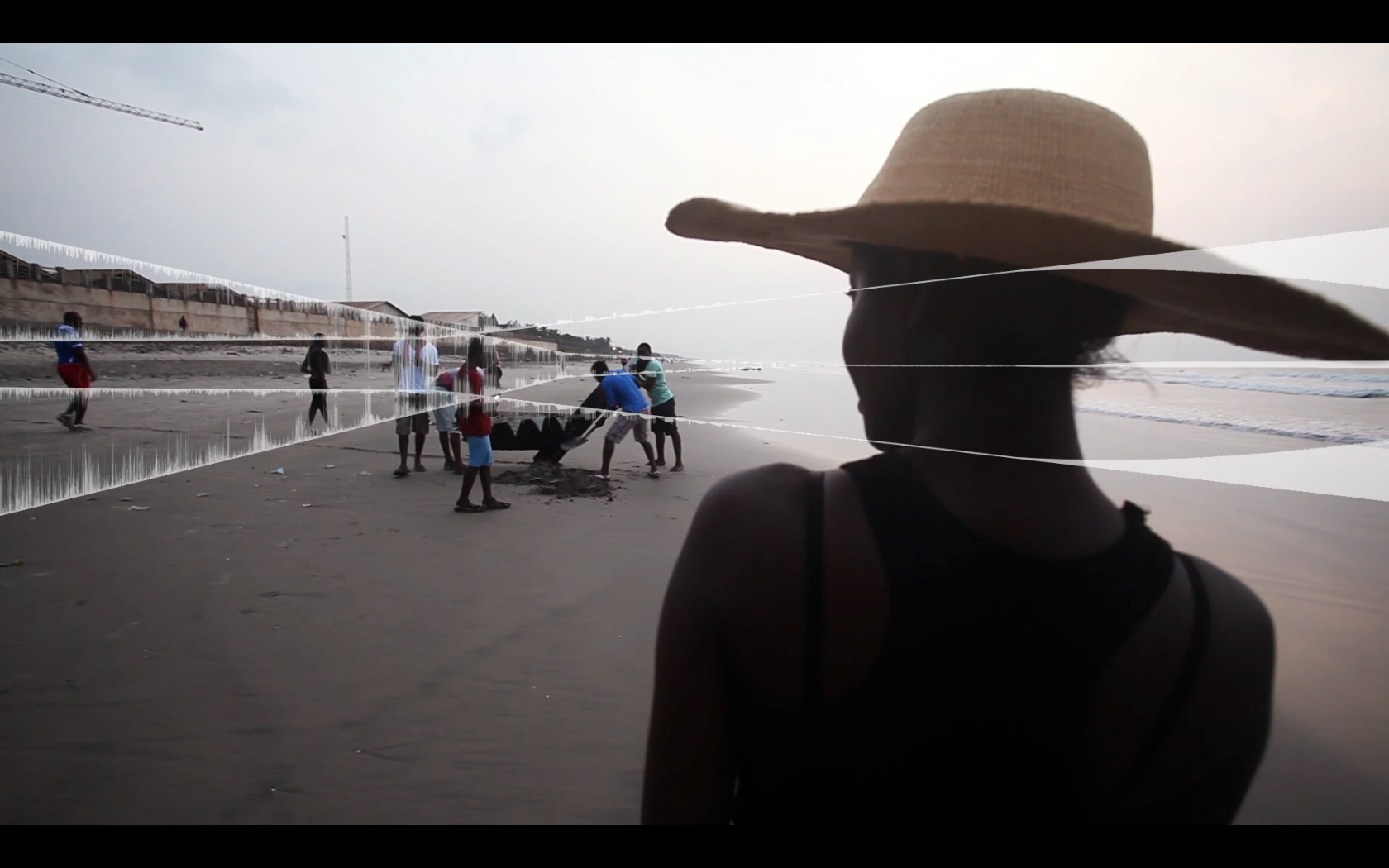
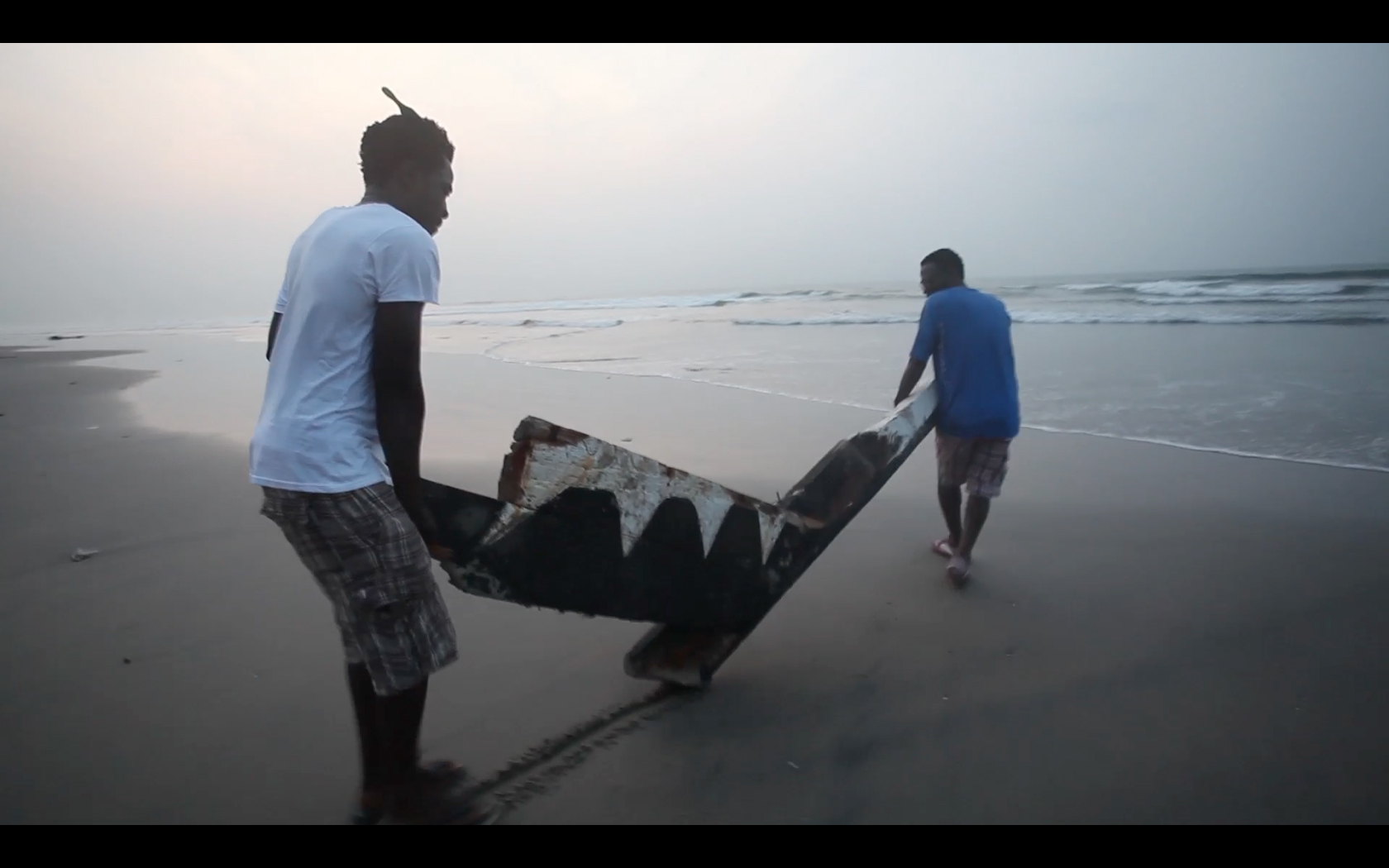
At the prelaunch of HADUWA ARTS & CULTURE INSTITUTE Daniel Aschwanden & Conny Zenk develop a set of scores in the frame of BASTARD CROWDING performed by Accra based performancegroup GOLOCAL: Daniel Clottey, Ralph Humble, Charles Nortey, Rhodaline Parlon HADUWA ARTS & CULTURE INSTITUTE is a meeting ground for artists and cultural practitioners in Africa and Europe to support excellence and diversity in and through the arts. HADUWA promotes understanding and enhances active local and international collaborations. The [a]FA LAB of the Institute of Architecture of the University of Applied Arts Vienna, together with the LAB DC, Accra, have been investigating stages and stagings. The aim has been to conceptualize and design a stage for the future initiatives of HADUWA. A unique bamboo structure, which serves as shared space, landmark and stage has been built by the [a]FA team, together with international and local experts and workers.
LABADI RISING | visionXsound
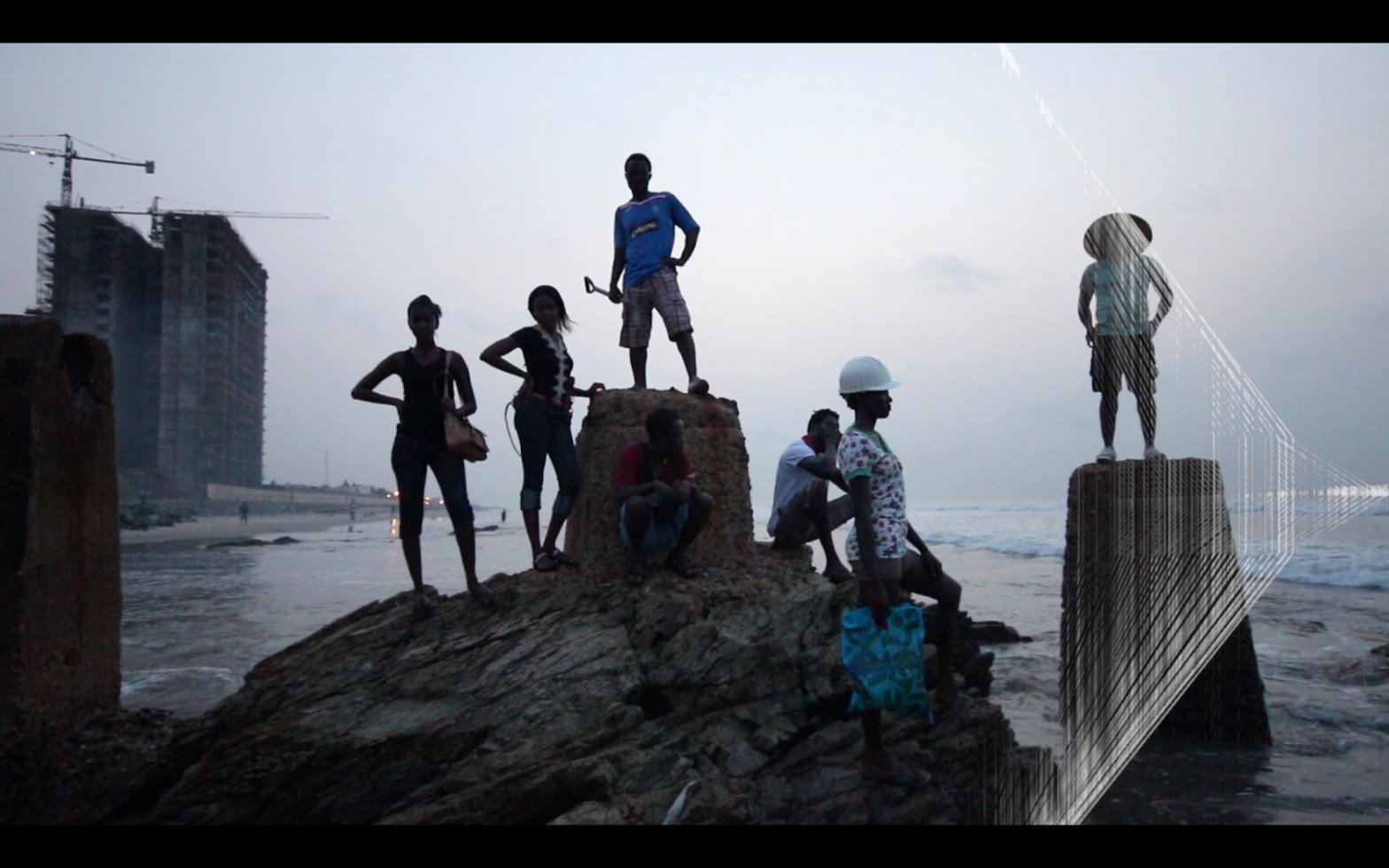
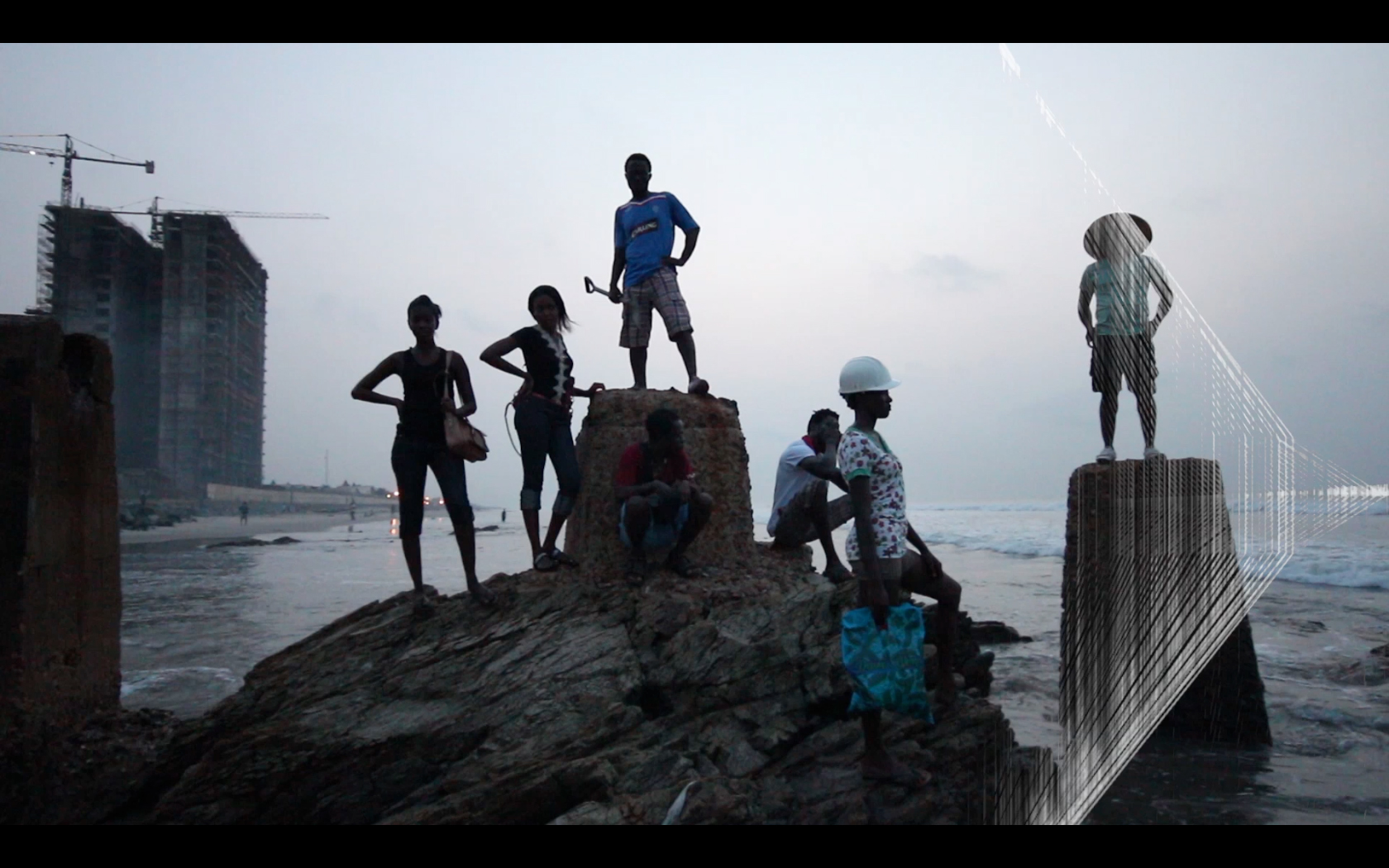
Labadi Rising, 2014
3 min 33 sec
Credits
performance group: GOLOCAL by Serge Clottey
directors: Conny Zenk / Daniel Aschwanden
camera: Conny Zenk / Daniel Aschwanden
animation & editing: Conny Zenk
sound: Matthias Hurtl
an urban sprawl, a gigantic, close-knit urban conglomerate along the westafrican coast from Abidjan to Lagos? The prediction of urbanist Mike Davis (planet of slums) fort he year 2050 could easily be outpaced by reality long before.
Labady, an area at the periphery, one of the many of Accra (and Kumasi) which weren ́t planned in british colonial ways nor do they manifest tropical modernism of the young independent period or resemble new investor ruled real estate but simply built , grown, ghanean historic city,even if some parts may appear slumlike these days. This area where the city is just about to merge with neigbouring portcity Tema is fitting exactly into this scheme.
Provided with exuberant creativity, trained in the daily struggle of a seemingly chaotic but highly flexible and as has been proven unbeatable subsistence economy along with resulting innovational strength young africans meet the challenges of everydaylife in the manifestations of concurrence, poverty, violence against weaker members of society, environmental pollution, corruption and exploitation through global capital ant there own elites.
Thats where Daniel Aschwanden, Conny Zenk und Mat Hurtl meet the performancegroup GOLOCAL around visual artist Serge Clottey, all of them in- habitants of Labady and improvise together a future scetch in this context in the public space of the beach area.
The longerlasting conceptualized artistic encounter is understood on both sides, the european as well as the african, as a field of experimentation to develop and strengthen the capacity to dialogue on eye level – under bothsided not easily to resolve postcolonial conditions. The development of this dialogue doubtlessly belongs to any contemporary and future scenario of african-european relations at all levels. Art in this context could provide new spaces and nonlinear models for encounter.
Kofi Setordji, internationally succesful visual artist of the older generation and instigator also for Accra ́s younger artscene as the founder and curator of the independent Nubuke foundation mentioned in a lecture about african art the fact that „here everybody is an artist, designer and marketingspecialist in everydaylife“ and subsequently the meaning of african art always can be seen as art of life, as applied art in this context.
The method of the collage, to be observed as a principle of life apparently omnipresent as a tool to appropriate symbolic as well as real territories serves as a matrix also for the videoshooting. The big themes are to be found in microspaces and depict themselves in surprizing transitions, tacked together in raw ways; the location, things, humans, actions, smells, realities, sounds, continuously measured again, built-in, destroyed, rearranged an applied, the construction of a future.
UPCOMING:
visionXsound:[KV-N] 2014 MEDIENKUNST-SCREENINGTAGE
06/09/2014 14:00 bis 22:00 A–Z
20/09/2014 14:00 bis 22:00 Z–A
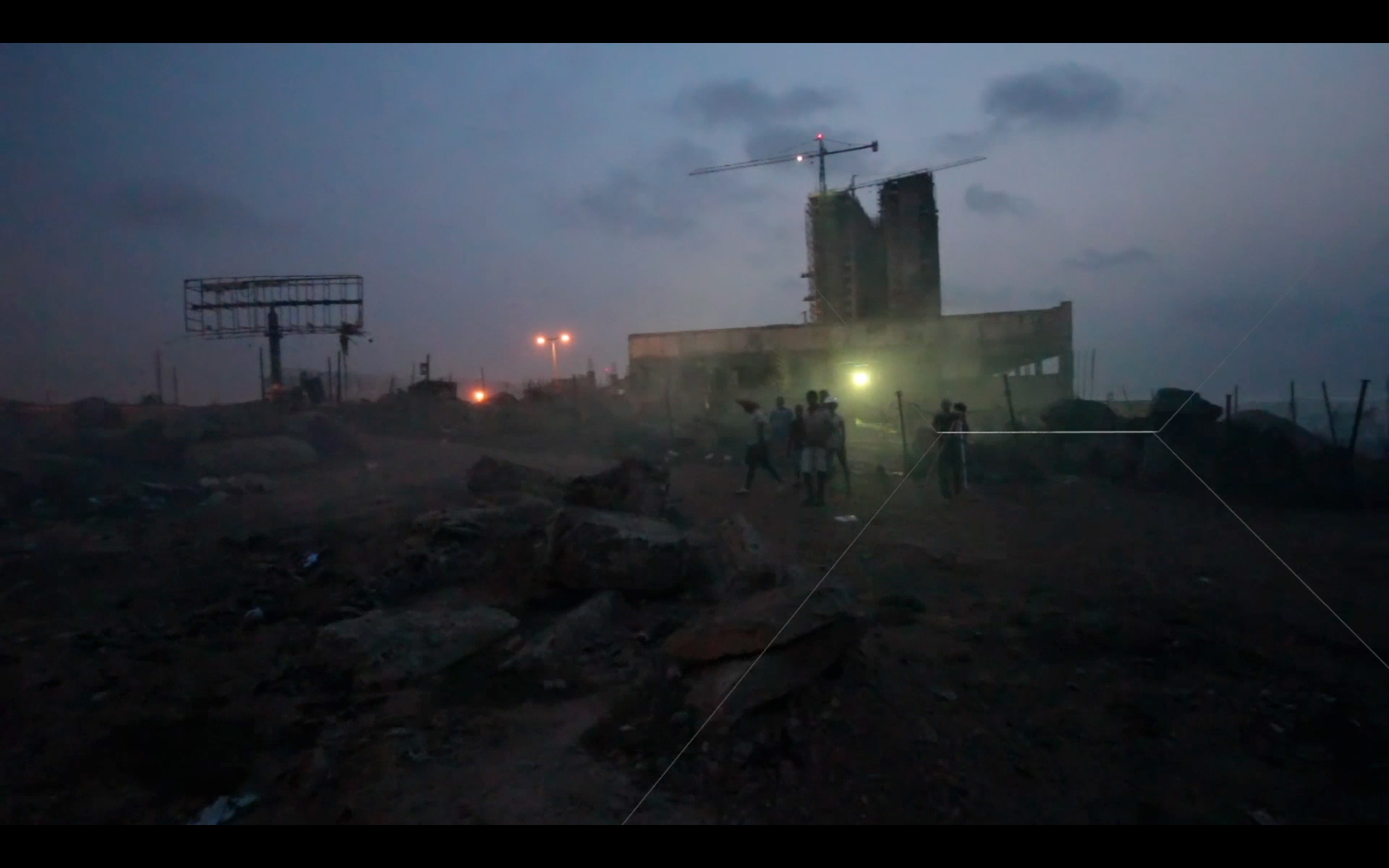
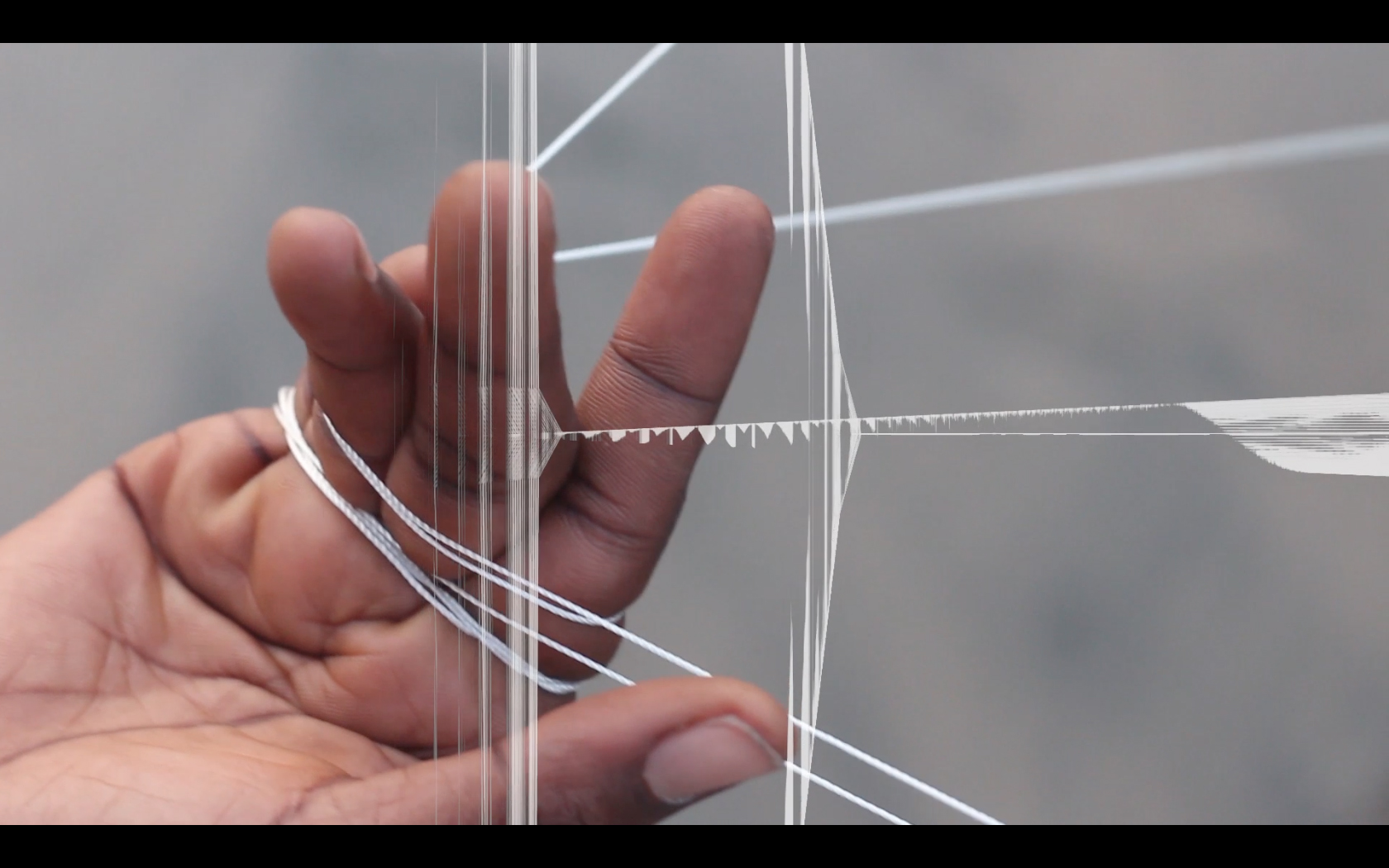
bastard.CROWD.[mobile]

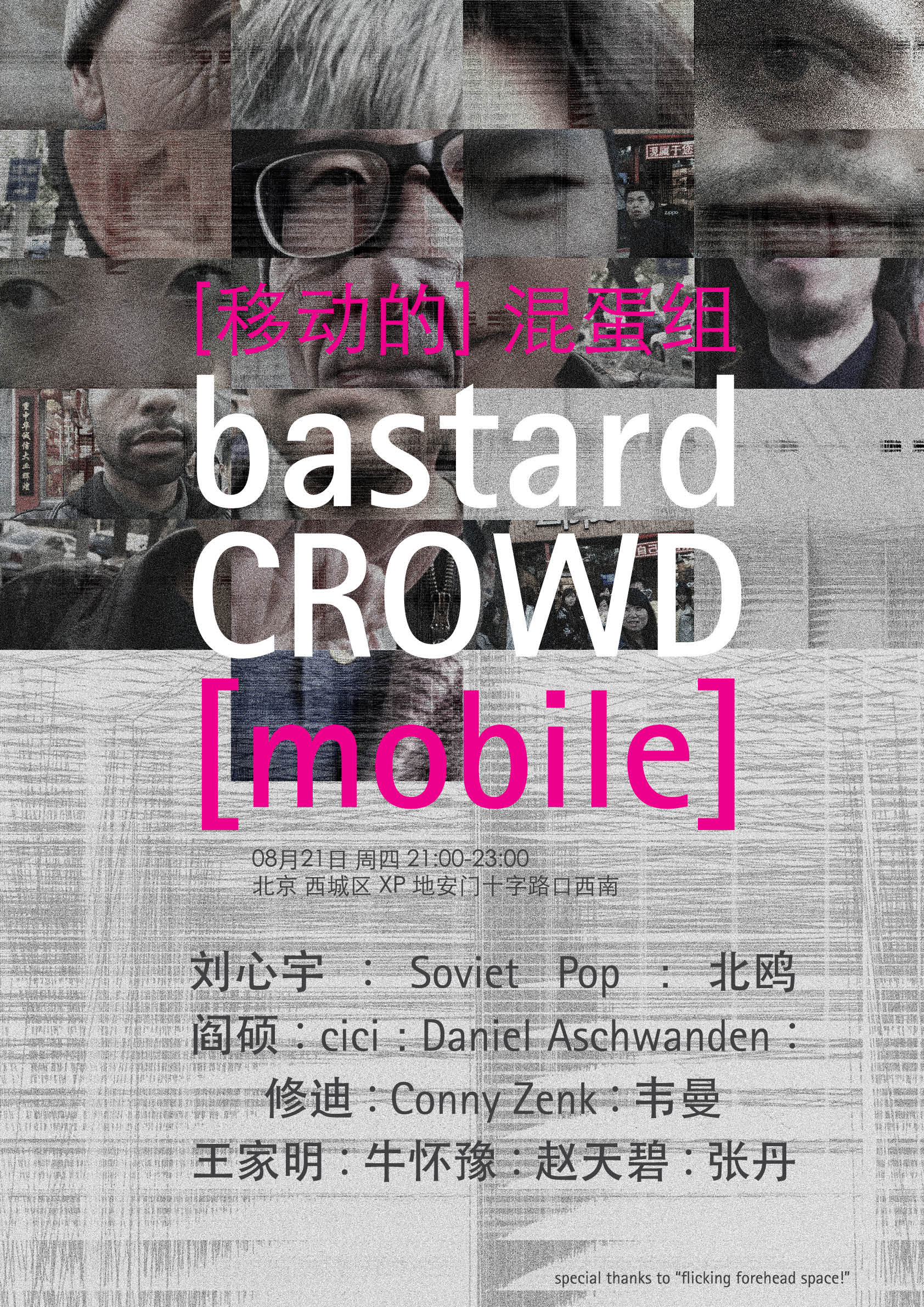
an evening of improvisation including dance, performance, experimental music and media in three sets
members of the „gadget –society“, come to join aproaches of re-analogisation, drift in (public) space and indulge in acts of happy self surveillance!
Scan yourself, share the images and show them to your neighbour while you observe him doing the same with you. It´s not just you looking at each other, your images are as well.
Which smartphone user could pretend never having used the built in selfie function?
The look at the screen has become more common then taking a look at the mirror in the morning at home, except you are alone in front oft he mirror. While taking a selfie you are always watched or at least someone could always be watching when you stream data into virtual techno-landscapes of gigantic dimensions, controlled by state agencies as well as multinational corporations.
We are not just part of our personal networks but as well part of an invisible mass, following programs and patterns which define our behaviour.
Formerly passive users or spectators have transformed into active participants of cultural production, Mirko T. Schäfer argues in his book „bastard culture“. „ Participation has become a key concept to get a hold of extending new media practices. He describes the conseqences as an „extension of the cultural industries“. The most diverse user groups and practices are overlayed with eachother. It´s this practice of overlaying the hybrid formats of choreographic interventions refer to, including users as well as the imageproduction of their smartphones.
http://www.douban.com/event/22378599/









supersuit . projection mapping


Intervention mit SUPERSUIT auf einer Brache im Stadtentwicklungsgebiet zwischen neuem Hauptbahnhof und ERSTE Campus in Wien.
SUPERSUIT als Kommentar zur Architektur rundherum.
Der SUPER SUIT changiert zwischen Anzug und Architektur und bekleidet einen Performer, der die öffentlichen Räume Wiens (und anderer Städte) erforscht und darin interveniert. Der Performer, in Symbiose mit seinem Anzug dehnt sich mit ihm spontan an unterschiedlichsten Orten und Plätzen aus, faltet einen Raum auf. Er kreiert eine urbane Bühne, die an Shakespears „Urbühnen“ erinnert, aber auch zum Marker öffentlichen Raumes wird. Er verweist auf den jeweiligen Ort und lädt rundherum zu spielerischer Aneignung ein. Nachts wird er beleuchtet, steht als Lichtinsel, bietet sich als Bildträger fürProjektionen aller Art, vielleicht auch nur für die Schatten vorübergehender Passanten an. Verlässt der Performer die Struktur, bleibt sein Abdruck auf der nun zur Architektur mutierten textilen Konstruktion zurück.
SUPER SUIT //EINE KOLLABORATION VON DANIEL ASCHWANDEN (AT/CH), MANORA AUERSPERG (AT), NIKI PASSATH (AT), MICHAEL WALLRAFF (AT) & KLAUS STATTMANN (AT)
Projektionen von Conny Zenk.
Crossbreeds – Supersuit
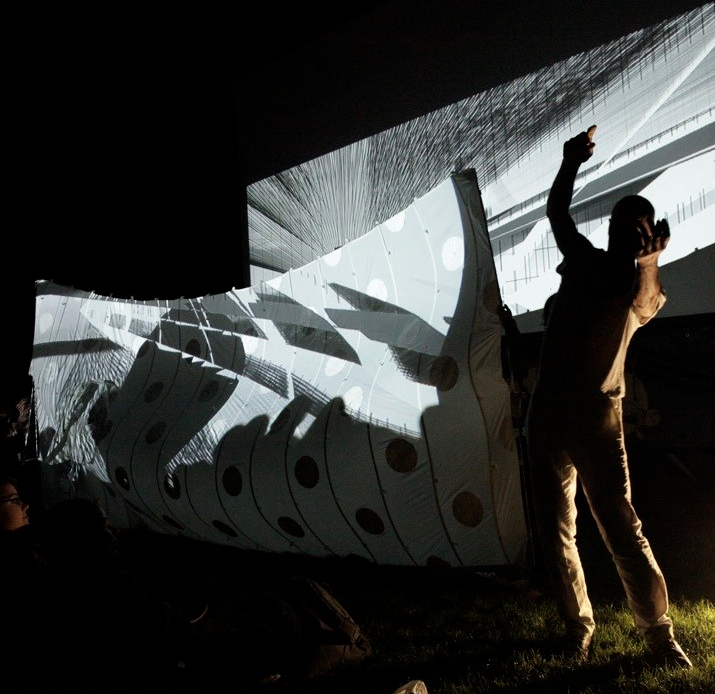
Projektion/ Visualisierung im Rahmen des Im_Flieger//CROSSBREEDS 2014 bei sciencefictionimpark.at
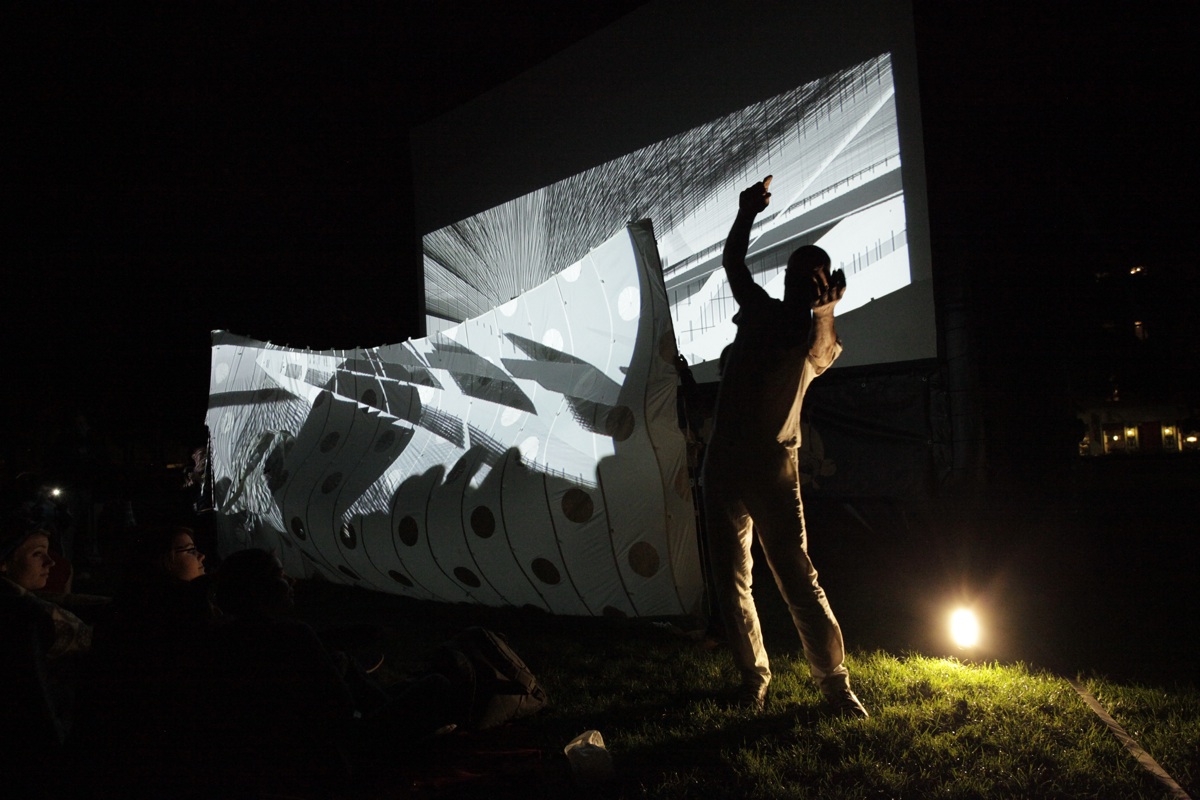
Der SUPER SUIT changiert zwischen Anzug und Architektur und bekleidet einen Performer, der die öffentlichen Räume Wiens (und anderer Städte) erforscht und darin interveniert. Der Performer, in Symbiose mit seinem Anzug dehnt sich mit ihm spontan an unterschiedlichsten Orten und Plätzen aus, faltet einen Raum auf. Er kreiert eine urbane Bühne, die an Shakespears „Urbühnen“ erinnert, aber auch zum Marker öffentlichen Raumes wird. Er verweist auf den jeweiligen Ort und lädt rundherum zu spielerischer Aneignung ein. Nachts wird er beleuchtet, steht als Lichtinsel, bietet sich als Bildträger fürProjektionen aller Art, vielleicht auch nur für die Schatten vorübergehender Passanten an. Verlässt der Performer die Struktur, bleibt sein Abdruck auf der nun zur Architektur mutierten textilen Konstruktion zurück.
Performance: Daniel Aschwanden
Sound: Matthias Hurtl
horizon
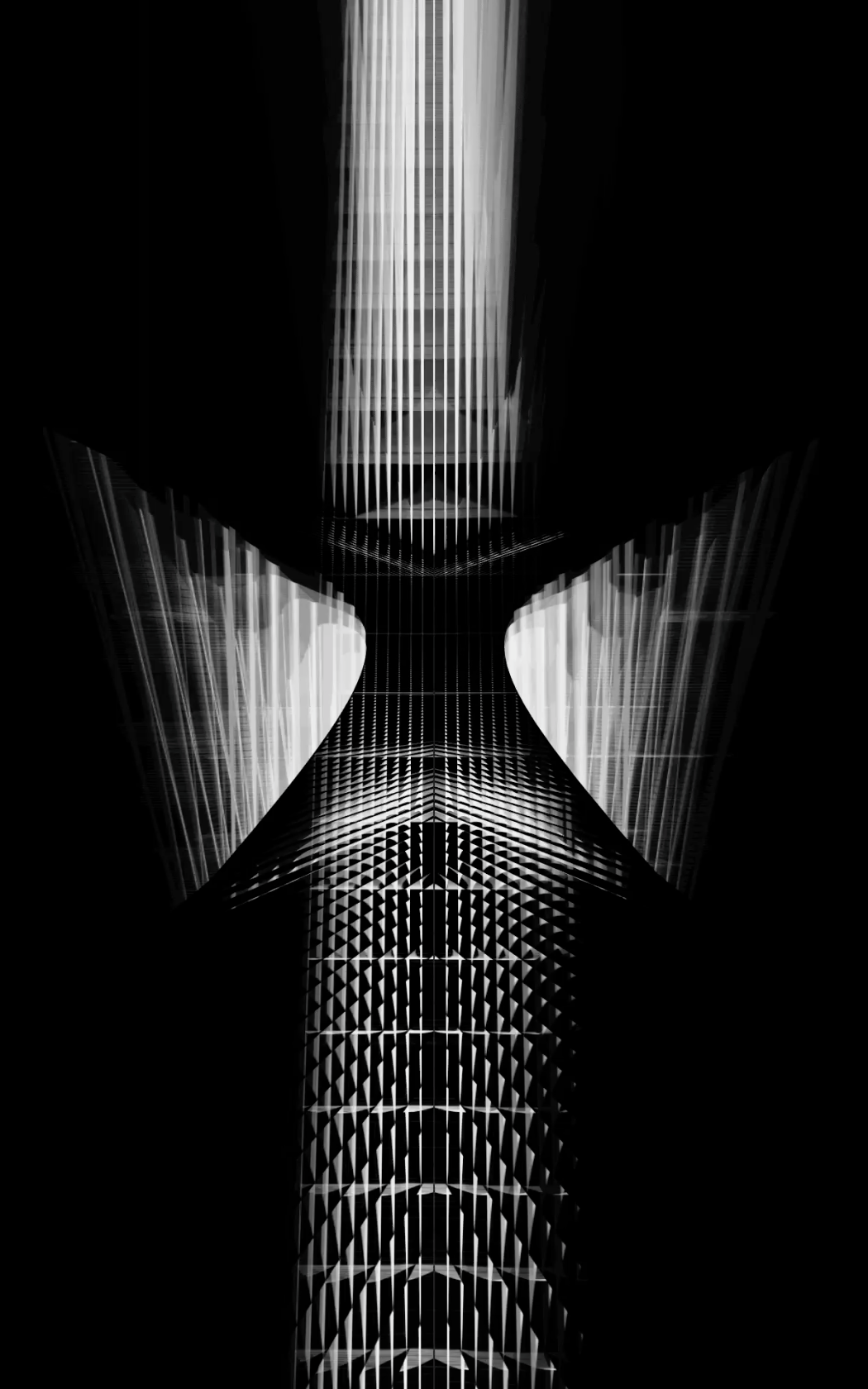
live visuals at sound:frame festival 2014
live visuals : Uli Kühn : Thomas Wagensommerer : Conny Zenk
live act : WIFE : RAS G
av live : LUMISOKEA : AntiVJ
brut Künstlerhaus
5th April 2014


sound:frame pics by Claudio Farkasch | Licht Schalter
CHORUS + BASTARD CULTURE
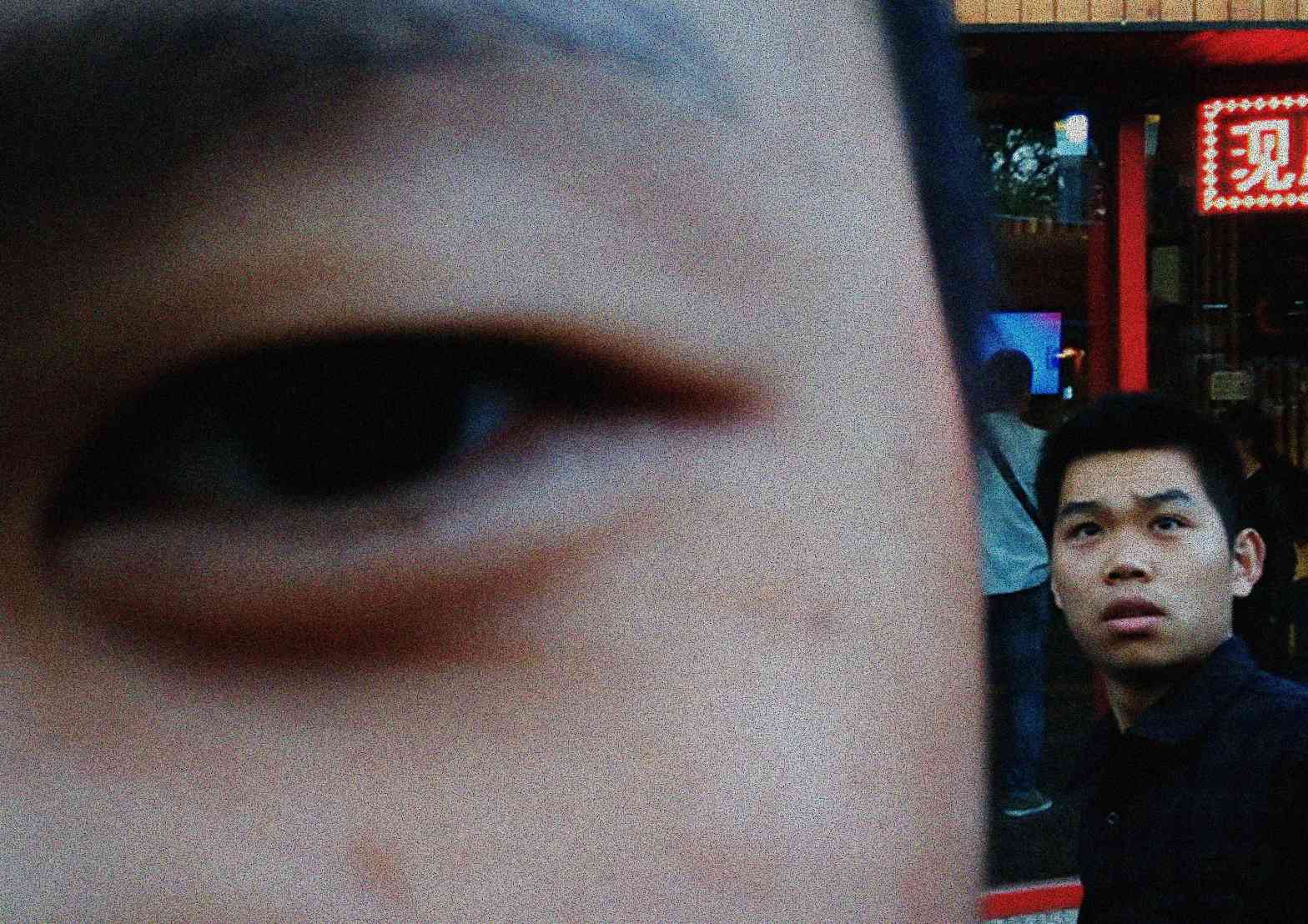
„How user participation transforms cultural production“ is one of the main questions in Mirko Tobias Schäfer’s book bastard culture. Participation has become a key concept and is used to frame emerging media practices. It considers transformation of former audiences into active participants and agents of cultural production. Schäfer describes the consequences of user participation as an extension of the cultural industries. The interactions between users and corporations, and the connectivity between markets and media practices, are inherently intertwined and constitute something he brashly dubbed “bastard culture” to indicate how the most heterogeneous participants and practices are blended together. It’s this practice of „blending together“ that constitutes our hybrid formats. We are questioning aspects of public space, participation and its rules, as well as practices of embodiment and connectivity – refering to the immense production of personal imagery and subsequent aspects of surveillance. This involves a simultaneous research of
interdependent fields. Will the greek chorus of the old times resurface out of the practice of blending the swarm of digital users and agents of image production with the resulting imagery and letting them act out their own practice of constantly chasing images?
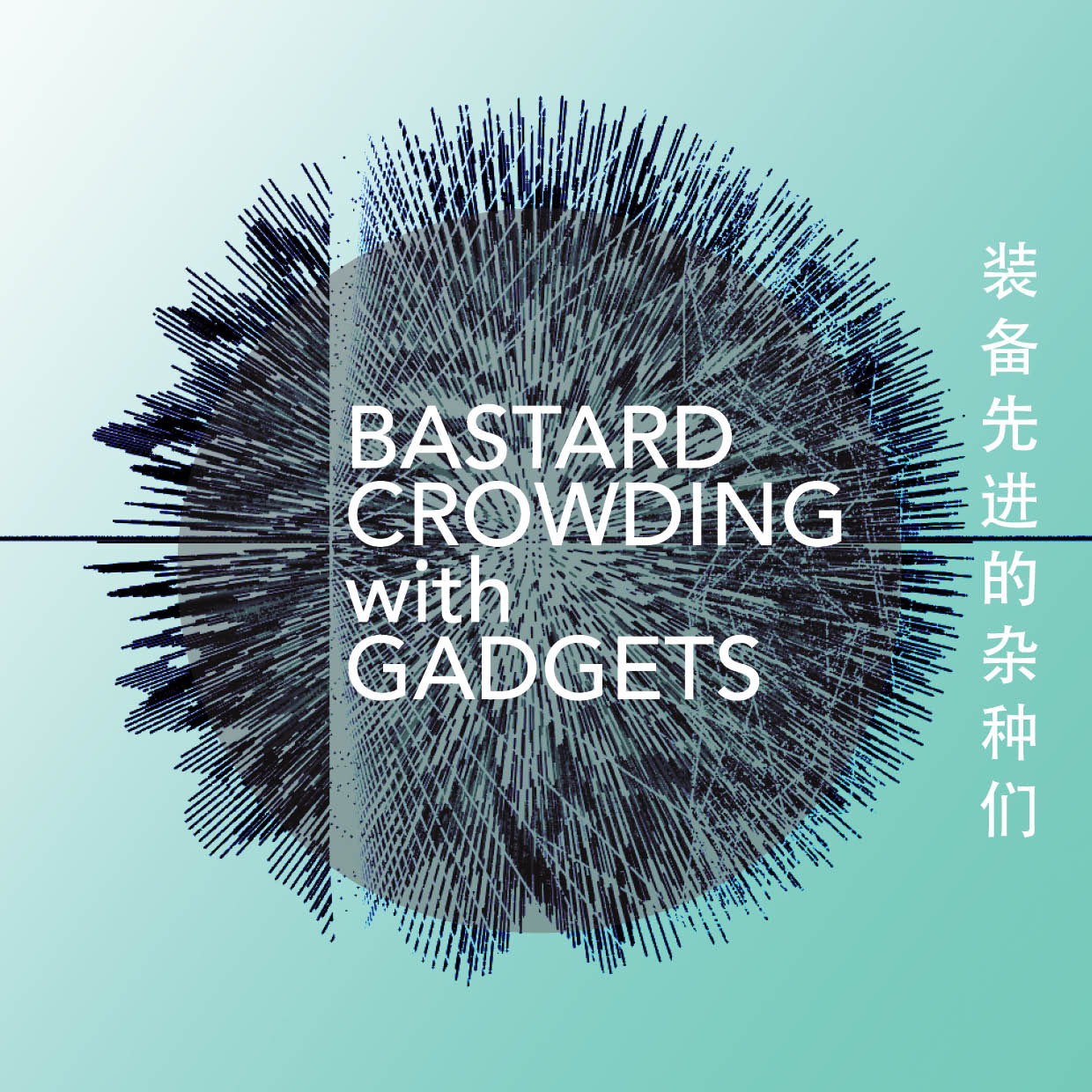
BASTARD CROWDING WITH GADGETS
In the course of new developments in computing, robotic and artificial intelligence, and the development of the internet in the late 80ies and early 90ies – research of swarm intelligence became of interest. Swarm intelligence (SI) is the collective behavior of decentralized, self-organized systems, natural or artificial. The concept is employed in work on artificial intelligence. The expression was introduced by Gerardo Beni and Jing Wang in 1989, in the context of cellular robotic systems. Parallel to this the swarm became established as a paradigm in analysis of social and cultural sciences, and in the public domain phenomenons as smart mobs appeared. I got to know choroegraphic practices of swarming or flocking for the first time in Tanaka Min´s Mai Juku Butoh workshop – an exercise named Tsuri Tsurare (riding the same wave) exercised a technique of feeling the movement intentions of neighbours and in such a way creating a sort of nearly simultaneous group movement reminding flocks of sheep or swarms of fish moving.
Flocking in the digital realm was analized when using the algorithms for programming behaviour of virtual entities. Basic models of flocking behavior are controlled by three simple rules:
1. Separation – avoid crowding neighbors (short range repulsion)
2. Alignment – steer towards average heading of neighbors
3. Cohesion – steer towards average position of neighbors (long range attraction)
With these three simple rules, the flock moves in an extremely realistic way, creating complex motion and interaction that would be extremely hard to create otherwise.
Recently scholar Mona de Weerdt wrote an essay titeled „swarm dynamics and social togetherness“ about an improvisation choreography by Tom Hauert and his group Zoo. „It´s about togetherness, social behaviour and the functionality of a non–hierarchic group, she states,“both phenomenons, the swarm and dance improvisation as well are being characterized by emergence, transitoriness and performativity.“
De Weerdt brings in Jean Luc Nancy and his approach of socialphilosophy of „the inbetween“ where the gaze is directed on the intermediate, which is happening between us. In Nancy´s book „singular–plural“ he asks himself the question, how we can think a WE without submitting this WE a substancial (in or exclusive)identity.
He puts an emphasis on the „being with“, which according to him is a being shared between us, a social fabric, separating as well as binding and in such a way a common form which is characterized by the plurality in being together and not through homogenous ideological synchronisation. In our crowding aproaches we examine and apply improvisational choreographic principles to interacting human bodies in urban space and include the use of gadgets of digital imageproduction such as smart phones and cameras. Departing from this we actually experiment with creating a second swarm besides a physical one in urban contexts – the second one consisting of the nonmaterial images every swarm-member is recording which are being transfered via an interfaces (mobile phones with Wi-Fi, mobile servers) to a digital space, and mapped into a 2D projection which eventually we project as a double layer of an intervention on surfaces in the environments we use.
Philosopher Byung Chul Han critically reflects the impact of „digital swarms“ in the public domain – in the internet as well as physically ( shitstorm). In the sense of this critique we create a direct and conscious embodiment of a swarmrelation between virtual and real space . We will work with trained dancers as well as non-professionals who are triggered in their physical behaviour by various scores like flocking and concentrating on the body as well as by the score to record others while they are recording others with digital gadgets.
workshop @zajia lab

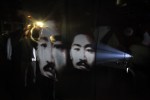
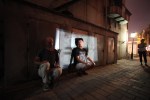
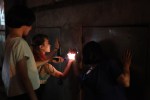
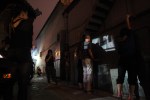
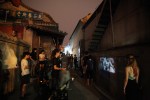
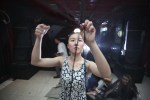
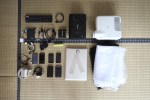
We are working and improvising with practices of „blending together“ different media, constituting hybrid formats including bodywork, performance as urban intervention and playing with gadgets. The workshops are aimed at people who want to investigate structures of public spaces that exist in the physical world and online and who would like to play with these in order to find new ways of using and questioning them.
2014
zajia lab – Beijing | China


workshop @flicking your forehead
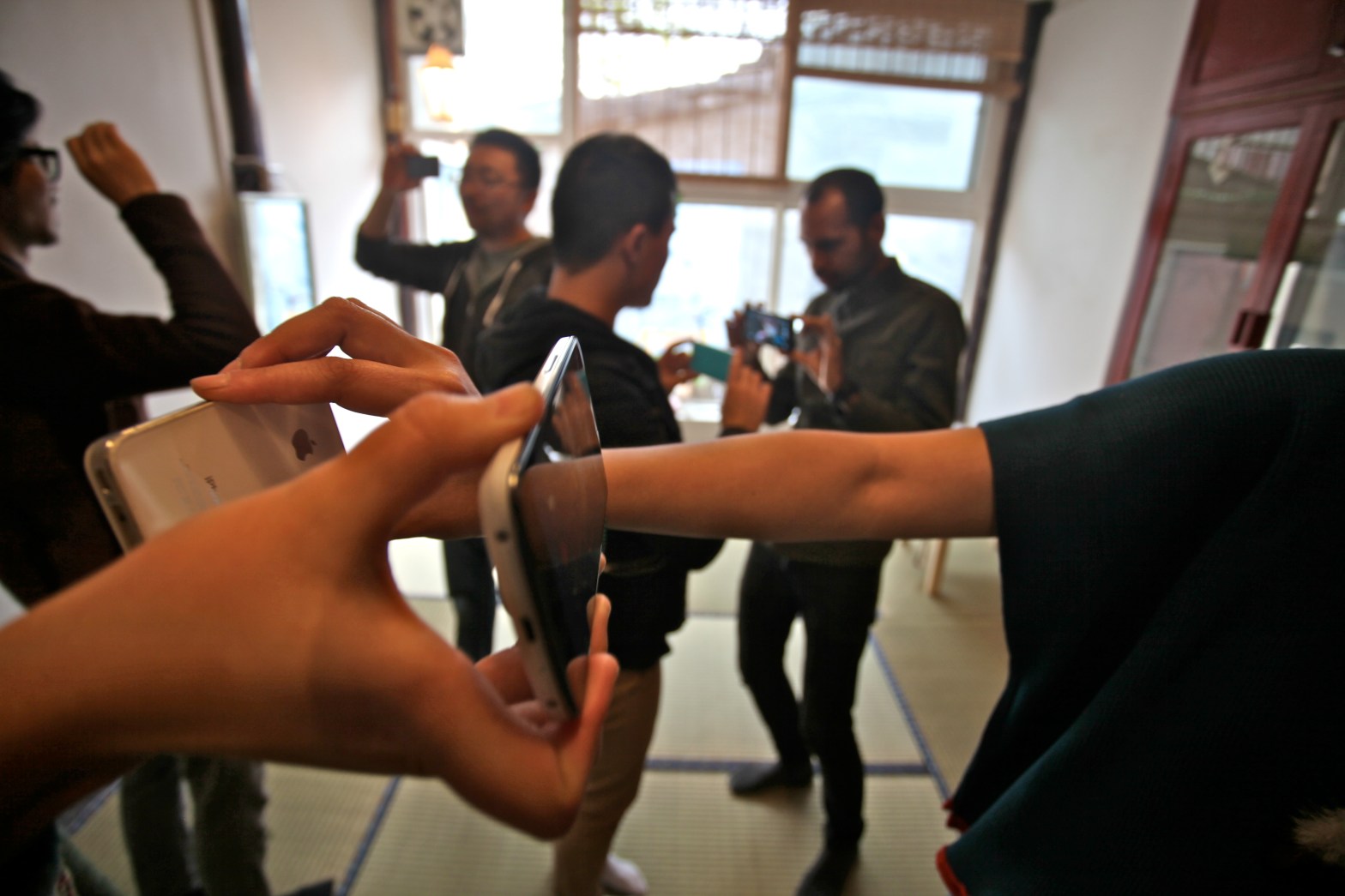
We are working and improvising with practices of „blending together“ different media, constituting hybrid formats including bodywork, performance as urban intervention and playing with gadgets. The workshops are aimed at people who want to investigate structures of public spaces that exist in the physical world and online and who would like to play with these in order to find new ways of using and questioning them.
2014
flicking your forehead, Beijing | China


UPCOMING WORKSHOPS | BEIJING

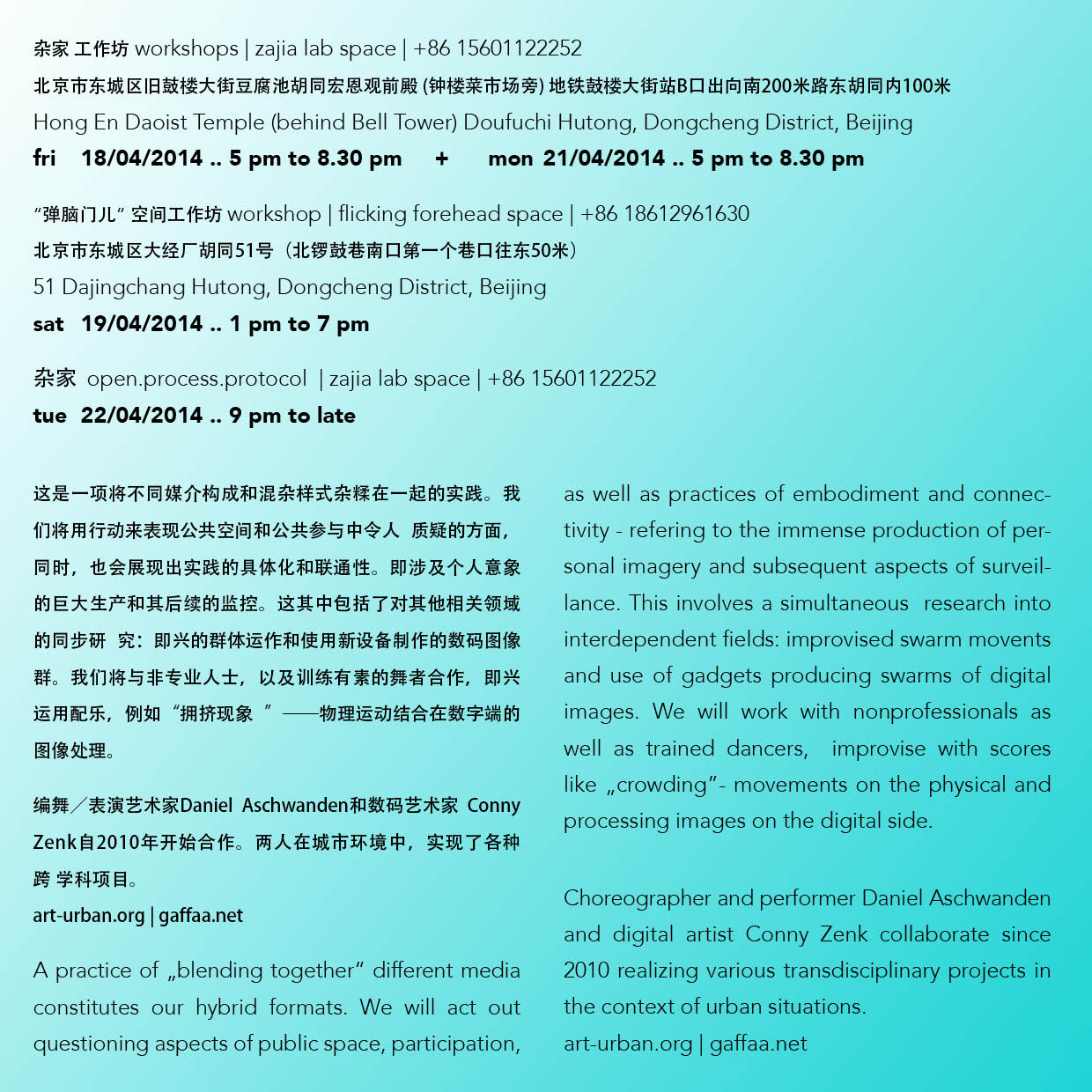
这是一项将不同媒介构成和混杂样式杂糅在一起的实践。我们将用行动来表现公共空间和公共参与中令人 质疑的方面,同时,也会展现出实践的具体化和联通性。即涉及个人意象的巨大生产和其后续的监控。这其中包括了对其他相关领域的同步研 究:即兴的群体运作和使用新设备制作的数码图像群。我们将与非专业人士,以及训练有素的舞者合作,即兴运用配乐,例如“拥挤现象 ”——物理运动结合在数字端的图像处理。
编舞/表演艺术家Daniel Aschwanden和数码艺术家 Conny Zenk自2010年开始合作。两人在城市环境中,实现了各种跨 学科项目。
A practice of „blending together“ different media constitutes our hybrid formats. We will act out questioning aspects of public space, participation, as well as practices of embodiment and connectivity – refering to the immense production of personal imagery and subsequent aspects of surveillance. This involves a simultaneous research into interdependent fields: improvised swarm movents and use of gadgets producing swarms of digital images. We will work with nonprofessionals as well as trained dancers, improvise with scores like „crowding”- movements on the physical and processing images on the digital side.
Choreographer and performer Daniel Aschwanden and digital artist Conny Zenk collaborate since 2010 realizing various transdisciplinary projects in the context of urban situations.
 Conny Zenk